Gergely Orosz is right: A lot of charts and benchmarks around AI have become increasingly difficult to take seriously.
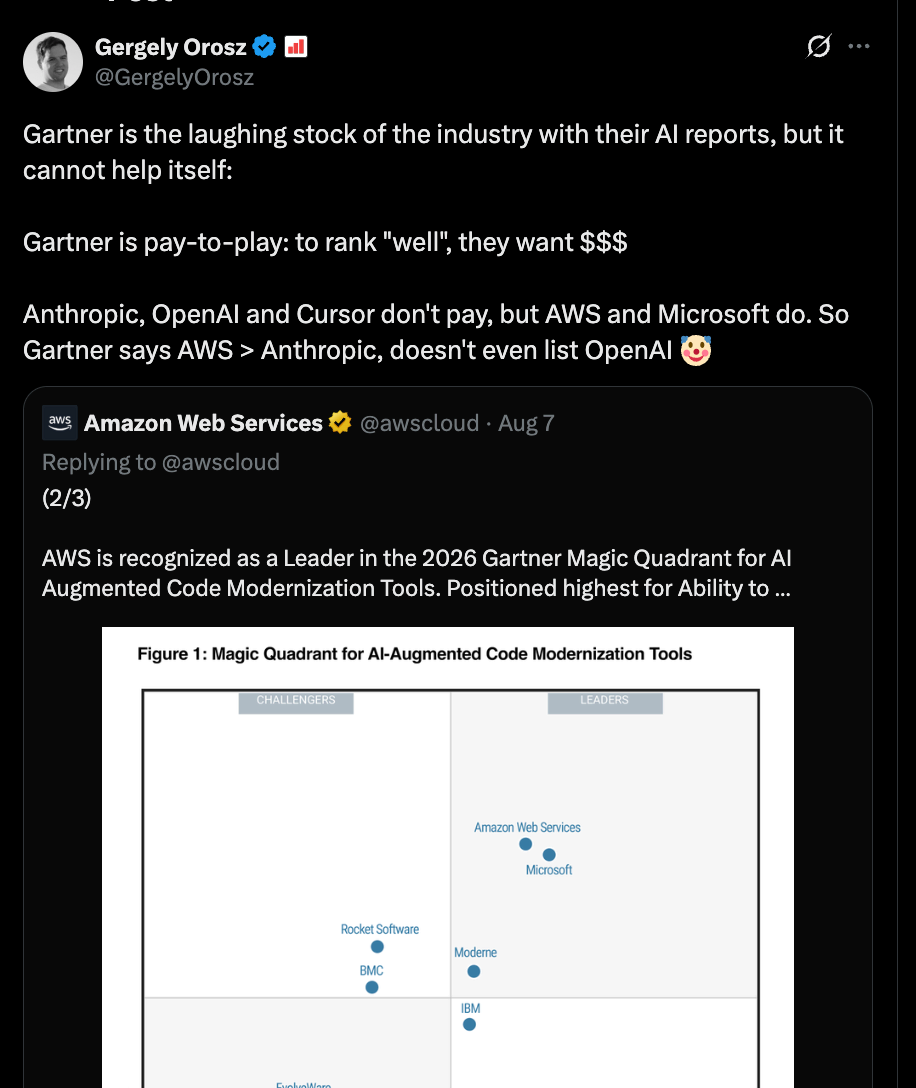
I can make one argument for placing AWS at the top of this particular chart.
AWS already has millions of businesses running on its infrastructure. If it successfully pushes AI-assisted code modernization into even a fraction of those companies, it could become one of the largest AI-modernization operations in the world almost by accident.
It is a numbers game.
At that scale, AWS also gets an experience arbitrage. Modernize enough enterprise software and you begin to see the same corpses everywhere: old Java systems, undocumented business logic, broken dependencies, Windows migrations, mainframes and decades of technical debt held together by people who retired six years ago.
That experience matters. AWS says Transform has already processed billions of lines of code and saved millions of hours of manual work. If Gartner is measuring distribution, revenue, enterprise adoption and the sheer volume of modernization completed, AWS has a serious claim to the top spot.
But that is where the chart stops making sense.
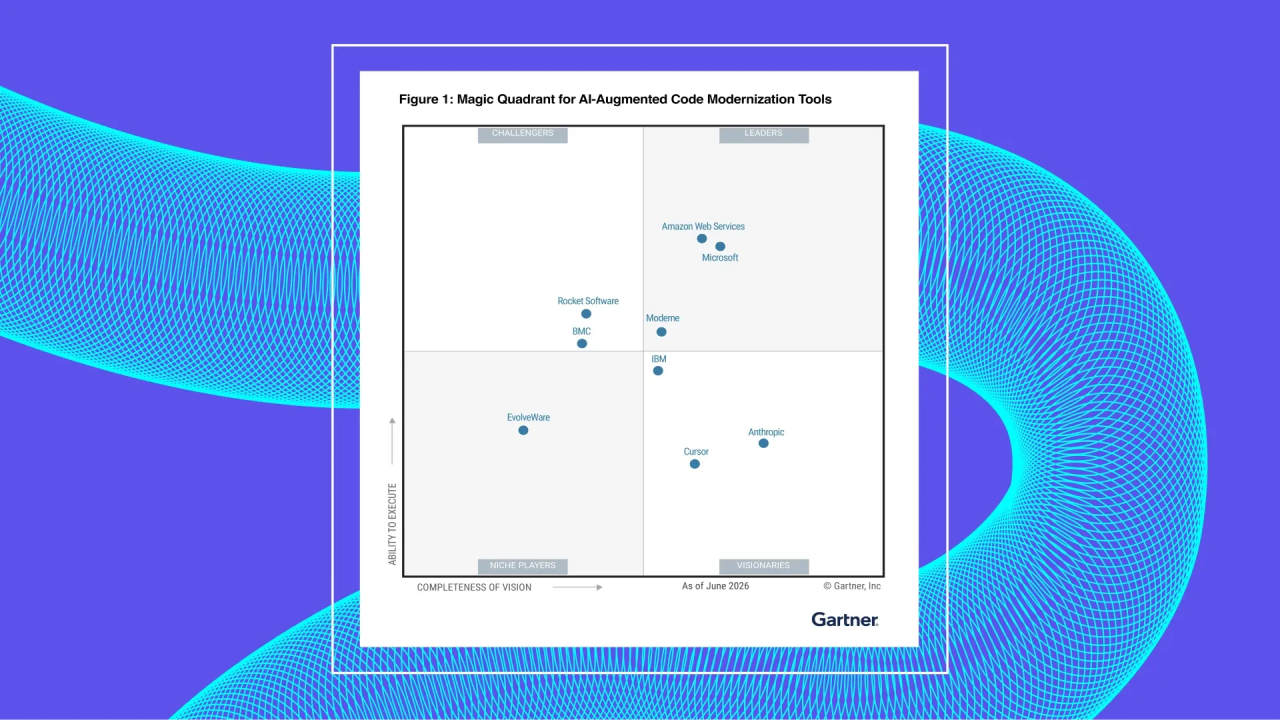
AWS and Microsoft are “Leaders.” Anthropic and Cursor are merely “Visionaries.” IBM supposedly has a greater “Ability to Execute” than both. OpenAI is missing entirely.
This may be a chart about AI-augmented code modernization rather than AI in general. Fine. But Gartner chose to call one corner “Leaders.” It cannot then act surprised when people ask what kind of leadership it is measuring.
Because this chart appears to confuse leadership with possession of a sales force.
If leadership means having thousands of enterprise account managers, existing procurement relationships and enough consultants to survive a nine-month vendor review, then say that.
AWS wins on distribution. Microsoft wins on enterprise relationships. IBM wins on its ability to sell extremely expensive things to companies that stopped asking whether those things were good years ago.
But that is not the same as leading a young industry.
When I think about leadership, I ask a different question:
What idea viruses has this company successfully spread?
What belief did it introduce that infected the rest of the industry? What idea forced competitors to react? What changed how people build, buy or think because this company pushed it into the world?
Anthropic has spread several.
It spent months warning that increasingly capable models could threaten the security of our online systems. It repeated the argument, published research, attached its reputation to the claim and helped drag the issue into government.
You can believe Anthropic is right, wrong or strategically terrified of regulation arriving without its fingerprints on it. That is beside the point.
Anthropic changed the conversation. Governments now discuss frontier-model security using a vocabulary Anthropic helped establish.
That is leadership.
Anthropic has also made a very clear bet about what AI is for: coding and work.
OpenAI is fighting on every available front: coding, healthcare, consumer assistants, enterprise software, writing, search, images and video.
Anthropic is more focused. It does not appear particularly interested in producing a Sora competitor or turning Claude into an entertainment machine. Its products are built around the work people do inside companies, including the boring work everybody needs and nobody wants to photograph.
Editing a PDF. Reading fifty documents. Understanding a codebase. Producing a usable report. Turning scattered information into an artifact somebody can actually send, review or act on.
These are invisible work tools. They are less glamorous than video generation, but probably more consequential to how companies operate.
Anthropic has pushed a specific idea into the market: AI should not merely answer questions. It should sit inside serious knowledge work and produce useful output.
That is an idea virus.
Cursor spread an even bigger one.
For years, the dominant belief was that the model was the product. Make the model smarter and every application built on top of it would improve automatically.
Cursor showed that this was incomplete.
Recommended by LinkedIn
[Curiosity AI Digest #66: Building the Agent Control…
Dwaraka Turlapati
4 months ago](https://www.linkedin.com/pulse/curiosity-ai-digest-66-building-agent-control-plane-aws-turlapati-mxtke)
[The $11 Billion Nervous System: Why IBM Bought…
Dr. Faustino Júnior
10 months ago](https://www.linkedin.com/pulse/11-billion-nervous-system-why-ibm-bought-confluent-what-j%C3%BAnior-mevff)
[The Machine Was Given Authority. It Used It.
Reuben Maher
6 months ago](https://www.linkedin.com/pulse/machine-given-authority-used-reuben-maher-orq5f)
The harness matters.
How the product retrieves context matters. How it understands the codebase matters. How it selects files, applies edits, uses tools and lets the developer review or correct its work matters.
A brilliant model inside a weak product is still a weak product.
That idea now appears everywhere. Every serious AI coding company talks about context, agents, tools, memory, planning and orchestration. The industry no longer believes intelligence alone is enough. Intelligence must be shaped into a reliable system.
Cursor did not merely build a popular editor. It helped move the perceived source of value away from the model alone and towards the machinery surrounding it.
That is leadership.
OpenAI and Anthropic helped spread the belief that smarter models would transform coding. Cursor proved that a strong product harness could capture enormous value around those models. Anthropic’s growing obsession with coding and tool use is, at least partly, evidence that Cursor was right about the size of the opportunity.
Then there is OpenAI.
Its absence is the most absurd part of Gartner’s chart.
OpenAI has created a dedicated deployment business and agreed to acquire Tomoro, a consulting and engineering company focused on enterprise AI integration. It is clearly not ignoring deployment, integration or code transformation. It is spending heavily to own more of that work.
Perhaps Gartner has a technical reason for excluding it. Perhaps OpenAI failed some narrow revenue, product-maturity or customer-reference requirement.
Then Gartner should make that reason impossible to miss.
Because without it, the chart looks ridiculous.
You cannot publish a chart about AI-assisted code transformation, include Anthropic and Cursor, leave out the company behind Codex and expect readers to treat the result as self-evidently authoritative.
That is the real problem with the chart.
It hides a narrow definition of leadership behind a universal-sounding label.
If Gartner is measuring enterprise distribution, AWS belongs near the top.
If it is measuring the amount of modernization already completed, AWS may belong at the top.
If it is measuring who can sell to a bank, survive procurement and deploy five hundred consultants into the resulting mess, AWS, Microsoft and IBM will naturally perform well.
But call that what it is: enterprise execution.
Do not confuse it with intellectual or technological leadership.
Because if leadership includes producing the ideas that determine where the industry moves next, the chart collapses.
What idea virus has AWS spread across AI coding?
What new belief did it introduce that forced Anthropic, OpenAI, Cursor or Google to respond?
What did AWS make the rest of the industry suddenly start saying, building or fearing?
I cannot immediately name it.
I can name several from Anthropic.
I can name several from OpenAI.
I can name one enormous one from Cursor.
Gartner’s chart may accurately measure who has the largest enterprise machine. But it does not tell us who is spreading the idea viruses in AI
It tells us who was already inside the building when AI arrived.
I would take it with a massive pinch of salt.
Originally published in Blackbox Thinking on LinkedIn.